By David Gee[i]
The modern bird is believed by the evolutionary scientists of our modern age to have evolved from reptilian ancestors, arising from the dinosaurs in a similar fashion to the mammals and modern reptiles. The believed driving force of this is natural selection pushing mutations in the direction of an arboreal and then flight based life-style.
Among many other problematic steps in the proposed evolutionary tree (e.g. life from non-life and evolution of insects to name two) is the step from reptiles to birds. This evolutionary step would better be described as a cliff than a step so great are the differences between the groups.
There has been much debate over the process involved in the evolution of birds even among evolutionists:
Alan Feduccia, a world authority on birds at the University of North Carolina at Chapel Hill, wrote an encyclopaedic book on living and fossil birds[ii]. He pointed out much evidence against the dinosaur-to-bird theory, including the huge differences in lung and embryonic thumb structure. With regard to evolution of flight in dinosaurs he commented: 'It's biophysically impossible to evolve flight from such large bipeds with foreshortened forelimbs and heavy, balancing tails.'
His colleague, University of Kansas palaeontologist Larry Martin, commented on the wishful thinking and bias of another 'feathered dinosaur' claim: 'You have to put this into perspective. To the people who wrote the paper, the chicken would be a feathered dinosaur.'[iii].
While there is honest science being done by some, the popular media on the other hand have acted in an entirely biased fashion. This is shown in a National Geographic article run on dinosaur-bird evolution[iv].
Dr Storrs Olson (Curator of Birds at the National Museum of Natural History of the Smithsonian Institution in Washington, DC), wrote in response to the NG article: 'The idea of feathered dinosaurs and the theropod origin of birds is being actively promulgated by a cadre of zealous scientists acting in concert with certain editors at Nature and National Geographic who themselves have become outspoken and highly biased proselytizers of the faith. Truth and careful scientific weighing of evidence have been among the first casualties in their program, which is now fast becoming one of the grander scientific hoaxes of our age-the palaeontological equivalent of cold fusion.'[v].
Many people view the evolution of birds as a given and assume there is solid science in support of the fanciful drawings and theories. This is a blatant fabrication and in this article I will seek to point to some of the major problem points in the theory of evolution with regard to birds.
Firstly a brief look at several supposed dinosaur/bird intermediaries that have been brought forward by the popular media and evolutionary scientists:
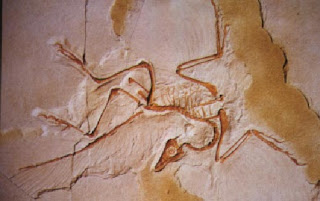 Archaeopteryx: For a long time thought to be a transitional form but in the words of Dr A Feduccia an evolutionist and ornithologist 'Palaeontologists have tried to turn Archaeopteryx into an earth-bound, feathered dinosaur. But it's not. It is a bird, a perching bird. And no amount of 'paleobabble' is going to change that.'[vi].
Sinosauropteryx prima: Many creationist were sceptical of this "feathered dinosaur" find and they were vindicated when four leading palaeontologists, including Yale University's John Ostrom, later found that the 'feathers' were just a parallel array of fibres, probably collagen[vii]. This conclusion was supported by later research by Dr A Feduccia[viii].
Mononykus: The cover of Time magazine even illustrated it with feathers, although not the slightest trace of feathers had been found[ix]. Later evidence indicated that 'Mononykus was clearly not a bird ... it clearly was a fleet-footed fossorial [digging] theropod.'[x].
Protarchaeopteryx robusta and Caudipteryx zoui: are claimed to be 'the immediate ancestors of the first birds.'[xi] but these two fossils are 'dated' 120-36 myo, while Archaeopteryx, a true bird, is 'dated' 140-150 myo, making these 'bird ancestors' far younger than their descendants! Dr Feduccia was not convinced, and neither was his colleague, University of Kansas palaeontologist Larry Martin saying: 'You have to put this into perspective. To the people who wrote the paper, the chicken would be a feathered dinosaur.'[xii]
Many of the design features in birds that mean they are impressively suited to a life in the skies. But there are two features in particular that are amazing in their complexity, efficiency and ingenuity: the avian lung and the flight feather.
Feathers
Feathers are amazing things, and if mankind could produce a material similarly suited to flight it would revolutionise the flight industry. Even the evolutionists point to their unique nature, Feduccia says 'Feathers are a near-perfect adaptation for flight'. They are lightweight, strong, aerodynamically shaped, and have an intricate structure of barbs and hooks. This structure makes them waterproof, and a quick preen with the bill will cause flattened feathers to snap into fully aerodynamic shape again. [xiii]
|

|

|
|
See the contrast here between the detailed structures of a feather (left) and scales (right), both magnified 80 times.
|
|
While there is no clear scientific rational for the gradual production feathers it is theorised: 'Feathers are modified reptilian scales,'[xiv] this is a widely held view among evolutionists. Scales are derived from embriologic folds in skin; feathers are complex structures with a barb, barbules, and hooks. They also originate in a totally different way, from follicles inside the skin in a manner akin to hair.
 To change from scale to feather the required increase in DNA information (complexity not quantity of DNA) would be huge to say the least. The structure would need be internalised in the skin and also produce the complex arrangement of the feather, all while providing an increase in fitness with each subsequent mutation. Again this is a point glossed over by evolutionists.
It has also been suggested that flight feathers began as insulation and progressed to flight feathers as time passed. The flight feather is an extremely poor insulator, whereas the fluffy down feather is an excellent insulator. Even if it was given that as some have suggested dinosaurs began with downy feathers. The selection towards insulation would select away from the development of hooks and barbs, as the loss of insulation would outweigh benefit in the movement towards flight feathers.
Also feather proteins (Φ-keratins) are biochemically different from skin and scale proteins (α-keratins). One researcher concluded:
At the morphological level feathers are traditionally considered homologous with reptilian scales. However, in development, morphogenesis [shape/form generation], gene structure, protein shape and sequence, and filament formation and structure, feathers are different[xv].
Lungs
The bird lung and associated systems are dumbfounding in both their efficiency and intricacy. A one way system of air sacs and a small light weight lung that maximises oxygen uptake. As described in creation magazine:
 As a bird breathes, air moves into its rear air sacs (1). These then expel the air into the lung (2) and the air flows through the lung into the front air sacs (3). The air is expelled by the front air sacs as the bird breathes out. The lung does not expand and contract as does a reptile's or mammal's. The blood which picks up oxygen from the lung flows in the opposite direction to the air so that blood with the lowest oxygen (blue in the diagram always means lower oxygen, red means high oxygen) is exposed to air with the lowest oxygen. The blood with the highest oxygen is exposed to air with an even higher oxygen concentration. This ensures that, in every region of the circulation, the concentration of oxygen in the air is more than that of the blood with which it is in contact. This maximises the efficiency of oxygen transfer from the air to the blood. This is known as counter-current exchange.[xvi]
The lungs of most other vertebrates are far less complicated and are variations on the theme of billows style lungs. The non-avian vertebrate lung is in essence a complex sack and the breathing is driven with either a diaphragm or similar muscular structure to propel air in and out. This system of respiration is efficient enough for low altitude living and flying (in the case of bats) but it is not suited to high altitude activity (just talk to any mountain climber).
The next obvious question is given these two systems are so disparate is it theoretically possible for the reptilian lung to evolve into an avian lung? Evolutionary theory demands that each subsequent change provide a greater advantage at every stage. In this scenario the lungs of hypothetical intermediate stages could not conceivably function properly, meaning the poor animal would be unable to breathe. So natural selection would work to preserve the existing arrangement, by eliminating any misfit intermediates.[xvii]
To illustrate this point I will refer to my work in the veterinary field. To progress towards an avian lung there would need to be air sacs formed which participate in breathing, a close parallel to this would be a diaphragmatic hernia/tear. Injured animals with tears to the diaphragm present with depression, breathing difficulties, inappetance and in the long term weakness and weight loss. It defies rationality that someone could suggest that animals in this condition are more able to compete than others.[xviii]
Evolutionists propose that birds evolved to better take advantage of the niche in the air, 'chasing the beetle' as such. Regardless of the other obstacles to this theory it is ridiculous to claim that birds would evolve such complex respiration to aid in flight. Bats with a standard mammalian lung are able to forage up to a height of 3km, thus only at very high altitude does the avian lung become an advantage. Natural selection does not drive evolution even in theory when there is no advantage in the changes.[xix]
Recent fossil evidence has been found which some believe point to certain dinosaurs possibly having avian style lungs. Majungatholus atopusi[xx], a theropod dinosaur has been found to have evidence of pneumatic invasion of the cervical, thoracic and abdominal vertebrae strikingly similar to modern birds. There are several points that must be noted in reference to this, as discussed in the Journal of Creation[xxi]:
- The bony pneumatizations in this theropod dinosaur are remarkably similar to those in birds, but according to several lines of evidence it can be assumed theropod dinosaurs are more similar to birds than to reptiles.
- It cannot be known for certain that theropod dinosaurs had any air sacs at all as modern birds do, although it is not an unreasonable inference that they had at least some, including an abdominal air sac. If on the other hand they did not have air sacs, then the pneumatizations discovered in the vertebrae presumably only served the function of lightening the bones for running.
- If they did have air sacs as birds do, there is no way of knowing whether they also had a flow-through lung like birds.An abdominal (caudal) air sac is necessary for a flow-through lung, but it does not therefore follow that having such a sac means one has a flow-through lung. The Nature authors believe theropods likely did have a flow-through lung, and cite certain features of the skeleton in support.But there have been other detailed studies suggesting theropods had a crocodile-like liver-pumping mechanism for ventilation.[xxii]
- Those evolutionists in the faction that believes dinosaurs (specifically theropods) gave rise to birds would be understandably encouraged by this paper, but it has not even begun to address the huge difficulties (including embryonic development paradoxes) pointed out by the opposing evolutionary faction.
- If it turned out that theropods did indeed have the same type of flow-through lung as birds, that would be an even bigger encouragement for the dino-bird faction, but it also fits perfectly comfortably within a creation framework; it would be a very reasonable design feature applied by a common Designer for fast-running small dinosaurs. However: Evolutionists would still be stuck with exactly the same massive problem of explaining the seemingly impossible transition from bellows to flow-through ventilation.
Conclusion
Someone I am sure will say at this point "So what? Evolution is still true". But these issues are unavoidable and their implications huge, for in the words of evolutionist Dr Michael Denton (in reference to evolution of the bird lung):
'I think it doesn't require a great deal of profound knowledge of biology to see that for an organ which is so central to the physiology of any higher organism, its drastic modification in that way by a series of small events is almost inconceivable. This is something we can't throw under the carpet again because, basically, as Darwin said, if any organ can be shown to be incapable of being achieved gradually in little steps, his theory would be totally overthrown. [xxiii]
Scientific theories claim to have power to explain some observed system, if an exception to a theory is found then the theory is modified. This is standard approach in the scientific community when practising honest science. Likewise the following should also happen: multiple contradictions are found and the theory fails to not only explain the systems/specimens found but the there is no way the systems/specimens could occur if the theory is truth. Logical conclusion - the theory is false and does not need to be revised but scrapped.
In the respects I have covered above and in several others avian species remain a group that roundly refutes evolutionary theory. The shear irrationality of claiming that birds arose by a series of small changes is astounding. Even the evolutionist camp when honest are uncertain this group could evolve. This is clear from Dr s Feduccia, Olson, and Denton. There is much disagreement over, no rational for, and a paucity of evidence to support the evolution of birds. If evolutionist's were honest, they like Dr Denton would admit that the problems with the evolution of birds are a death blow to the theory they hold as a quasi-religious world view.
Interestingly, some defenders of dinosaur-to-bird evolution discount the evidence against their theory by saying, 'The proponents of this argument offer no animal whose lungs could have given rise to those in birds, which are extremely complex and are unlike the lungs of any living animal.'[xxiv] Of course, only evolutionary faith requires that bird lungs arose from lungs of another animal. As opposed to the biblical creation model which dictates the bird kind were made this way by a creator, thus needing no precursor from another animal.
The bird is an amazing combination of design features that would be sufficient to make any engineer green with envy. The creation model is the only theory that will account for the features of extant and extinct birds but evolutionists will not accept it, why is made clear by Sir Arthur Keith:
"Evolution is unproven and unprovable, but we believe it because the alternative is unthinkable."
So evolutionists commit themselves to a theory which is unworkable in the face of all they know and all that logical scientific thought tells them. I among others hope that they will change their minds before they choke to death on the chicken bone in their scientific throat.
[i] I am deeply indebted to Creation Ministries for large portions of this article and give my grateful thanks to Dr Jonathan Sarfati and Dr Carl Wieland for their articles on this subject. Most of the scholarship is theirs, I would like that made clear from the beginning.
[ii] Feduccia, A., The Origin and Evolution of Birds, Yale University Press, New Haven and London, 2nd Ed.,1999
[iii] Cited on the CNN website <http://www.cnn.com/>, June 24, 1998
[iv] Sloan, C.P., Feathers for T. Rex?, National Geographic 196(5):98-107
[v] Olsen, S.L., Open letter to: Dr Peter Raven, Secretary, Committee for Research and Exploration, National Geographic Society, emphases added
[vi] Cited in V. Morell, Archaeopteryx: Early Bird Catches a Can of Worms, Science 259(5096):764-65, 5 February 1993.
[vii] New Scientist 154(2077):13, 12 April 1997; Creation 19(3):6, June-August 1997
[viii] 'Do Feathered Dinosaurs Exist?: Testing the Hypothesis on Neontological and Paleontological Evidence', by Alan Feduccia, Theagarten Lingham-Soliar, and J. Richard Hinchliffe, Journal of Morphology 266:125-166, 2005
[ix] Time (Australia), 26 April 1993
[x] D.P. Prothero and R.M. Schoch, editors, Major Features of Vertebrate Evolution, On the Origin of Birds and of Avian Flight, by J.H. Ostrom (Knoxville, TN: University of Tennessee Press, 1994), p. 160-177
[xi] Ji Qiang, P.J. Currie, M.A. Norell, and Ji Shu-An, Two Feathered Dinosaurs from Northeastern China, Nature 393(6687):753-761, 25 June 1998. Perspective by K. Padian, same issue, p. 729-730
[xii] Cited 24 June 1998, CNN website <www.cnn.com>
[xiii] A. Feduccia, The Origin and Evolution of Birds (New Haven, CT: Yale University Press, 1996), p. 130.
[xiv] R. Dawkins, Climbing Mount Improbable (Harmondsworth, Middlesex, England: Penguin Books, 1996), p. 113.
[xv] A.H. Brush, On the Origin of Feathers, Journal of Evolutionary Biology 9:131142, 1996.
[xvi] Blown Away By Design, Creation 21(4):14-15 September 1999
[xvii] Refuting Evolution: A handbook for students, parents, and teachers countering the latest arguments for evolution by Jonathan Sarfati, Ph.D., F.M.; Creation 21(4):14-15; September 1999
[xviii] Michael Denton, Blown Away By Design, Creation 21(4):14-15
[xix] Ibid
[xx] O'Connor, P. and Claessens, L., Basic avian pulmonary design and flow-through ventilation in non-avian theropod dinosaurs, Nature 436:253-256, 14 July 2005
[xxi] Carl Wieland, Dinos breathed like birds?, Journal of Creation 19(3):11-12, December 2005
[xxii] Forster, C.A., Sampson, S.D., Chiappe, L.M. & Krause, D.W., The theropod ancestry of birds: new evidence from the Late Cretaceous of Madagascar, Science 279, pp. 1915-1919, 1998. Also Sereno, P.C., The evolution of dinosaurs, Science 284, pp. 2137-2147, 1999.
[xxiii] The quotations in this article were extracted (with permission) from a video interview available on cassette (NTSC) from Access Research Network, PO Box 38069, Colorado Springs CO 80937-8069, USA. It was then re-checked with Dr Denton to ensure it fairly represented his current views. Emphasis added. Quoted in xvii
[xxiv] K. Padian and L.M. Chiappe, The Origin of Birds and Their Flight, Scientific American 278(2):38-47, February 1998, p. 43.




 Others had tried to find an answer in geological processes—e.g. the pattern was caused by the way the magma was emplaced or how it crystallized. This is indeed the answer in some cases.2,3 But Drs Humphreys and Baumgardner realized that in other cases there were many independent lines of evidence that suggested that huge amounts of radioactive decay had indeed taken place. (These include the variety of elements used in ‘standard’ radioisotope dating, mature uranium radiohalos and fission track dating.) It would be hard to imagine that geologic processes alone could explain all these. Rather, there was likely to be an answer that concerned the nuclear decay processes themselves.
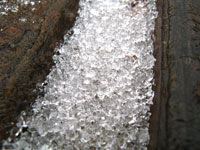 This appears to have been somewhat spectacularly supported when Dr Baumgardner sent five diamonds to be analyzed for 14C. It was the first time this had been attempted, and the answer came back positive—14C was present. The diamonds, formed deep inside the earth, are assumed by evolutionists to be over a billion years old. Nevertheless they contained radioactive carbon, even though, if the billion-year age were correct, they ‘shouldn’t have’.


