Thursday, July 9, 2009

Is Absence of Evidence, Evidence of Absence? Part 2

Continued from Part 1

4. Some Examples: Tooth Fairies, Leprechauns, Santa Claus, Teapots, and Invisible Objects

Let me see if I can put all this together to answer your question with some examples which are thought to pose a problem for the line of thought defended thus far. Your question basically was when absence of evidence counts as evidence of absence. Answering this will depend upon whether our epistemic situation satisfies the Evidence Expectation and Knowledge Expectation Criteria for the object in question: Should one expect to possess evidence sufficient to know that object O exists? If a rhino were in the room, then the answer is “Yes.” Thus, looking about and seeing no rhino, that itself is evidence there is none present.

But what about things like the Tooth Fairy, leprechauns, and Santa Claus? Atheists claim they don’t need to disprove God for the same reason they don’t need to disprove the existence of Tooth Fairies, leprechauns, and Santa Claus. The problem with the comparison with the last two items is that, while our epistemic situation regarding God doesn’t always satisfy the Evidence Expectation and Knowledge Expectation Criteria, our epistemic situation regarding leprechauns and Santa Claus does — we can, and do, disprove them all the time; it’s just that there are few, if any, people arguing for their existence so we’re never called upon to give those reasons. If Santa existed we should expect to see, but don’t, lots of evidence of that fact, including warehouses at the North Pole, a large sleigh, and so forth; similarly, were there biologically tiny human beings on this planet we should expect to see, but don’t, their evidence: miniature villages, waste products, the bones of their deceased — evidence similar to what we have for mice, hamsters and other small critters. If there were more people today who made a case for leprechauns and Santa Claus then it would be entirely appropriate for us to enter into dialogue with them, giving reasons for their non-existence.

At this point an atheist might object that the Tooth Fairy is different from leprechauns and Santa Claus because she’s invisible. (Is she invisible in the story?) Suppose she is invisible. According to the tale she collects teeth left under children’s pillows leaving behind a reward (usually money). Evidence we should expect to see if she existed then would be money left behind, stolen teeth, etc. Do we find such evidence? Well, no we don’t, but we would expect to if she existed. So, even the Tooth Fairy satisfies the Evidence Expectation and Knowledge Expectation Criteria. So because we lack evidence of her, we say she doesn’t exist (sorry kids!).

Suppose the atheist agrees that the reason why we deny Tooth Fairies, leprechauns and Santa Claus is because we do have evidence for their absence. He might nonetheless insist that the situation is significantly different for other objects which are causally isolated from us. A case in point is Russell’s famous teapot which circles about the sun, an object which is (for the most part) causally isolated from us. Do we need to be agnostic about it? Can we say it doesn’t exist? I think we know it doesn’t exist because it wasn’t put there by the Russian or American astronauts; and we know that matter in the universe does not self-organize into teapot shapes. So really, we have a great deal of evidence that Russell’s teacup doesn’t exist; and since our discussion is confined to cases where we infer the non-existence of something simply on the basis of absence of evidence for it, the example is irrelevant.

Another Objection and a Reply

But now imagine the atheist objecting:

OK, very well, I grant everything you say thus far about Santa Claus, and all the rest; but we don’t have to abide by your Criteria when it comes to objects which are both invisible (like the Tooth Fairy) and causally undetectable (like the teapot). For example, an invisible floating, pink elephant over my head. There’s no such thing.

The theist could reply:

Your example is charming and rhetorically clever but incoherent. Can something that is invisible even be an elephant? If so, then it surely isn't very much like a normal elephant— a massive, material object which exhibits all sorts of physical properties. Your “invisible elephant” question is really just a rhetorically clever sleight of hand; the question doesn’t make much sense in the first place and perhaps should be rephrased as something like: "Do we know there are not immaterial things around us?" to which the answer should be "No" in either of two senses: (i) No, because we have no evidence that there are not immaterial things, or (ii) No, because there are immaterial things around us, e.g. God, angels, immaterial minds, qualia, abstract objects like numbers or propositions, etc.9

Source: ReasonableFaith.org

Sunday, July 5, 2009

Is Absence of Evidence, Evidence of Absence? Part 1

By Shaun

1. Introduction

The famous British philosopher Bertrand Russell was asked what he would say if he found himself before God on Judgment Day and God said to him, “Why didn’t you believe in Me?” Russell shot right back: “Not enough evidence, God! Not enough evidence!”

Many have taken what they consider to be an apparent lack of evidence for God as evidence that God doesn’t exist; that is, they look around, don’t see “enough” evidence and conclude that atheism is true.

But Russell realized that the inference from apparent lack of evidence for God to atheism is fallacious. That’s why in his famous debate in 1948 with Frederick Copleston he preferred the label “agnostic” instead of “atheist.” Yet today, many call themselves “atheists” when really they are agnostics.

Let’s first define some terms around the question “Does God exist?”

"Does God exist?"

Theism: "God exists"

Non-theism: "I don't believe in God"


Agnosticism: “I don’t know if God exists”

Atheism: “God does not exist”

Hard Agnosticism: "I don't know
if God exists and no one else can
know either."

Soft Agnosticism: "I don't know
if God exists, but it's possible for
someone to know."

Notice a few things about these definitions. First, non-theism and agnosticism are not mutually exclusive because you could be a non-theist and so fail to believe in God (i.e., you could lack belief in God) but you might also be an agnostic saying, “For all I know, God exists. I just don’t know.” Notice also how extreme hard agnosticism is, since it claims even more than atheists do; the hard agnostic says that everyone is wrong, both atheists and theists, and that they cannot know what they claim, even if they have apparently sound arguments! Little wonder, then, that hard agnosticism is sometimes called “ostrich agnosticism!”

There are sound arguments for God’s existence. Some of them are very good. But suppose it were not so; suppose all the arguments for God fail and there are no further good reasons to believe in God. What follows?—Atheism? It’s very important to realize that the answer to this question is NO. What follows is, at most, soft agnosticism.


2. When Does Absence of Evidence = Evidence of Absence? (Or, when is the inference from “I see none” to “there is none” valid?)

What I have said so far raises the question, When does the absence of evidence become evidence of absence? This is a good question because sometimes (but not always) the former implies the latter. Let’s start with some examples to work with.

Example 1. Elephants in the Room (Absence of Evidence = Evidence of Absence)
Someone asks, “Are there any elephants in the room?” After looking about and seeing none, I say, “No, I see none. There are no elephants in the room.”

The inference from “I see none” to “There are none” in this example is justified. With respect to elephants in this room, I’m not agnostic; rather, I positively affirm: There are no elephants in the room. In this case, absence of elephants in the room is evidence of their absence. But this inference doesn’t hold for Example 2.

Example 2. The Grand Canyon Fly (Absence of Evidence ≠ Evidence of Absence)
We’re standing atop the Grand Canyon and someone asks, “Is there a fly way down there?” After a quick glance I say, “No, I see none. There is no fly down there.”

As in the last example we move from “I see none” to “There is none”—but unlike the last example the conclusion is unjustified. Agnosticism regarding the fly is the appropriate response here. So in the Elephant Example we don’t have to be agnostics, but in the Grand Canyon Fly Example we do. Why? Notice that it is not the relative size of the object which creates the difference (The zookeeper might have asked you on your zoo trip, “Do you think an elephant is in the cage in the next room?” to which your reply might be agnosticism: “I have no idea. Maybe.”)

The salient difference between these two examples has entirely to do with your epistemic situation — which is, roughly, the extent and limits of your ability to know something through your primary sources of knowing (i.e. perception, memory, introspection, testimony, etc.) — and the fact that only in one situation (Elephants in the Room) do we expect to have knowledge which we lack. My epistemic situation regarding knowing whether an elephant is in the room is quite good, while my epistemic situation regarding knowing whether a fly resides at the bottom of the Grand Canyon is quite poor. Why? When are we in an epistemically good situation in order to say, “There is no X”? What conditions have to be met? At least two. In the absence of evidence of an object O you may deny that O exists only if these Criteria are met:

Evidence Expectation Criterion. If an object O existed, then we would expect there to be evidence for it.

Knowledge Expectation Criterion. If there were evidence of object O, then we would expect to have knowledge of the evidence.

In short, in the absence of evidence, we can deny the existence of something O only if we should expect to possess evidence sufficient to know that O exists but in fact lack it.

To prove his position the atheist has his task cut out for himself: What he must do is show that (a) the epistemic situation in which we find ourselves with respect to belief in God’s existence satisfies the above Criteria; and (b) demonstrate that we lack sufficient evidence for knowing that God exists. Equivalently, he must show that all the arguments for God are unsound and then argue that if God existed then we would expect to be in a position to know whether God exists. But as we’ll see, there is good reason to think (a) is false because our epistemic situation in which we find ourselves with respect to belief in God’s existence does not satisfy the above Criteria.

Source: ReasonableFaith.org

Read Part 2

Monday, June 22, 2009

An Atheist's Attempt at Refuting the Kalam Argument by Disproving the Universe

By Ryan Hemelaar

The Kalam Cosmological Argument is a very strong argument for God's existence. However, the leader of the Brisbane Atheists thinks that he has found a way to refute it. To summarise his argument:

1. There is an equal amount of matter and anti-matter in the universe.
2. Negative one plus one equals zero.
3. Therefore, the sum of the total matter of the universe is equal to zero.
4. Therefore the universe does not exist.
5. Therefore the universe never had a beginning.
6. Therefore there was no cause to the universe

As you can probably already see, there are many problems with this argument.

Firstly, there is no evidence to think that there is an equal amount of matter and anti-matter in the universe. Some Big Bang theorists speculate that there should have been equal amounts of matter and anti-matter made at the Big Bang. However, no anti-matter domains have been detected in space within 20 megaparsecs (6.17*10^20 km) of the Earth.

Even one of the leading advocates in the search for antimatter in space, Samuel Ting, laments:

"At the beginning, equal amounts of matter and antimatter were created [in the “big bang”]. Now there seems to be only matter. There have been theoretical speculations about the disappearance of antimatter, but no experimental support." [1]

Secondly, it is a total misunderstanding to think that even if there was an equal amount of matter and anti-matter in the universe that therefore nothing exists. That is as illogical as saying that if I have a certain amount of debts and a certain amount of money, therefore I have zero money. Even if on balance it does equal out as nothing, the debts still exist and the money still exists, they're not nothing. Similarily, even if the matter and anti-matter were on balance, equal, the anti-matter still exists and the matter still exists!

Thirdly, his conclusion that the universe does not exist I think is absurd. As Descartes said, I at least exist. Even when I doubt that I exist, who is there to do the doubting? I doubt, therefore I am. There simply must be something that exists.

So in conclusion, this Atheist's attempt at refuting the Kalam Cosmological Argument falls down at numerous points. Therefore, if one cannot refute the Kalam argument, a rational person is still obligated to believe that God exists.

Notes

[1] Antia, M., Ready to takeoff, antimatter experiment takes some flak, Science, 280:1339, 1998.

Saturday, June 13, 2009

Seven Signs of Evolution Refuted - Part 7

The last sign, #7, is “Lizards lose limbs”

Australian lizards called skinks are dropping their limbs to become more like snakes. And, according to a genetic family tree, some skinks have gone snaky in just 3.6 million years, relatively fast in evolutionary time. Scientists said the skinks’ lifestyle appears to be driving the change: They spend most of their time swimming through sand or soil. Limbs are not only unnecessary for this, they may be a hindrance. Once a skink goes snaky, they never go back, the researchers add. One of the snakelike skinks is shown here.12
Lizard

If amoebas are going to evolve into avocados and archaeologists the organisms continually need to produce new structures. For natural selection to change a fish into an amphibian, for example, it needs to put legs on a fish. But here we see a process, a mutation that takes legs off. Mutations also remove eyes from fish. Mutations are going the wrong way. So, how did the legs get on the lizard in the first place? Not by natural selection. Note too that it does not take millions of years for a lizard to lose its legs. Just one mutation in one generation will do the trick. The loss of legs on lizards is consistent with, and thus points to the truth of, the biblical account of how the world came to be the way it is today—lizard leg loss is not a “sign of evolution”.

Source: Creation Ministries

< Part 6

Friday, June 12, 2009

Seven Signs of Evolution Refuted - Part 6

Sign #6: “Intermediate form supports flatfish evolution”

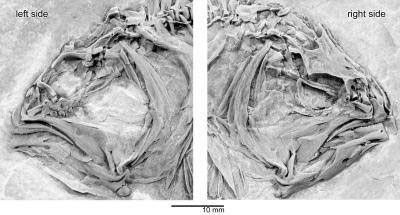
Flounder, sole, halibut and other flatfish have long struck biologists as evolutionary oddities: Both their eyes are on one side of the head, an adaptation that allows them to lie flat on the ocean bottom while keeping their eyes on the lookout for passing prey. The transition happens in the youth of flatfish, one eye migrating up and over the top of the head. Opponents of evolution argued that this curious anatomy could not have evolved gradually, as suggested by the theory of natural selection. That’s because there would be no advantage for an intermediate form –a fish with an only partially migrated eye. But now scientists have found those intermediate forms in museum collections. The 50 million-year-old fossils, including Heteronectes chantei shown here, have a partially displaced eye.

When flatfish die today they are not generally fossilized. Scavengers continue to eat their remains until there is nothing left. To fossilize a flatfish you need to bury it under sediment quickly. If a young flatfish was suddenly buried when its eye had only migrated part of the way around its head it would look just like the fossil pictured. It would not be a new species.

The sedimentary rocks of the world are filled with fossils that point to rapid burial. One example is a fish entombed in the act of swallowing another fish. Another is an ichthyosaur snap frozen in sediment while giving birth. The global Flood described in the Bible explains why we find so many fossils buried in sediment laid down by water all over the earth. Buried only 4,500 years ago, not 50 million years, sign # 6 is a powerful sign for creation.

Source: Creation Ministries

< Part 5 | Part 7 >